
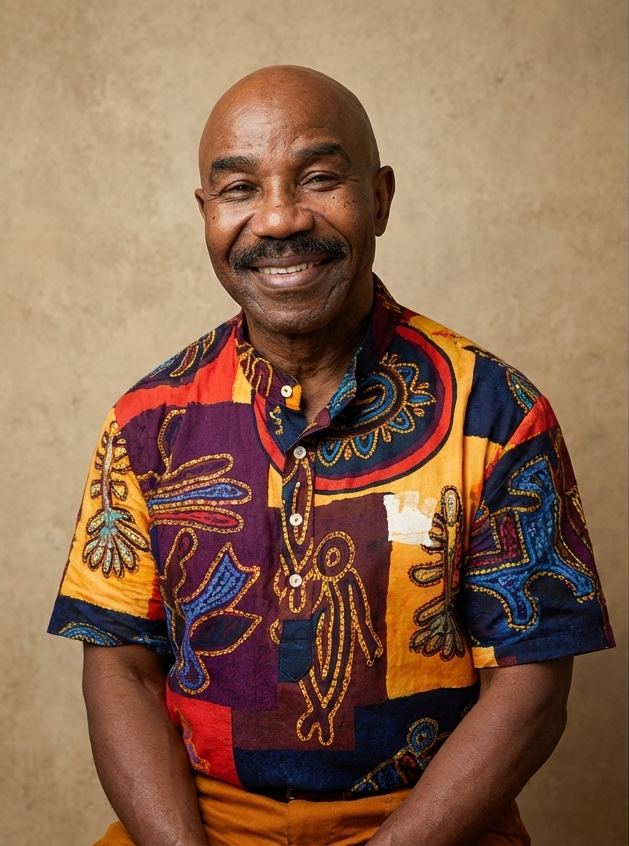
Artist, storyteller and witness to the enduring struggle for freedom.
Ulrick creates work that refuses to let us forget. His art serves as a testament to Haiti's revolutionary spirit and the ongoing fight for justice, dignity, and liberation that his homeland has come to symbolize globally.
Through oil paintings, he shares the people, moments, and traditions that have shaped Haiti and the African diaspora, bearing witness to histories too often overlooked.
Born in 1955 in Roseaux, Haiti, Jean-Pierre began drawing at age four and painting by sixteen. He trained under Haitian masters at the Foyer des Arts Plastiques in Port-au-Prince, including Louverture Poisson, Rosemarie Desruisseaux, René and Lavorancy Exumé, Enguerrand Gourgue, and Archibald Lochard. Invited to the United States in 1977, he exhibited his early works in solo shows at Drexel University and continued his studies at the University of the Arts in Philadelphia, drawing inspiration from historical archives. He is currently based in Atlanta.
Jean-Pierre’s paintings interpret the essential elements of Haitian history and culture through a lens that bridges past and present and connects Haiti to the world. He has painted Haitian historical figures as well as creating commissioned portraits of notable individuals such as President Jimmy Carter, which can be found at the Jimmy Carter Presidential Library, and Chief Justice Bernette Joshua Johnson, the Supreme Court of Louisiana’s 25th Chief Justice and its first African-American Chief Justice and the second female Chief Justice in Louisiana.
Exhibiting continuously for decades, his work has appeared nationally and internationally at institutions including the George and Leah McKenna Museum of African American Art, Meadows Museum of Art, Contemporary Arts Center (New Orleans), the Spencer Museum of Art at the University of Kansas (Lawrence, Kansas) and the National Museum of Haiti (Port-au-Prince, Haiti). Through bold imagery and unflinching perspective, Jean-Pierre preserves memory, honors lived experience, and challenges viewers to engage with Haiti’s enduring legacies and the African diaspora’s histories.
How I work
Jean-Pierre’s practice begins with observation, research, and reflection. Every painting emerges from a deep engagement with history, culture, and spiritual tradition.
“My work is not decoration. It is documentation. It is devotion. It is defiance.”
Narrative Power
He studies archival materials, interviews, and oral histories to ensure that each figure, ritual, and symbol is rendered with authenticity and respect. His process balances meticulous technical skill with narrative power, creating works that are both visually compelling and historically grounded.
Lasting impact
Whether capturing a revolutionary moment, a ceremonial object, or a portrait, Jean-Pierre seeks to awaken viewers—to preserve memory, honor lived experience, and invite reflection on the forces that continue to shape Haiti and the African diaspora today.